
SPACE December2025 (No. 697)
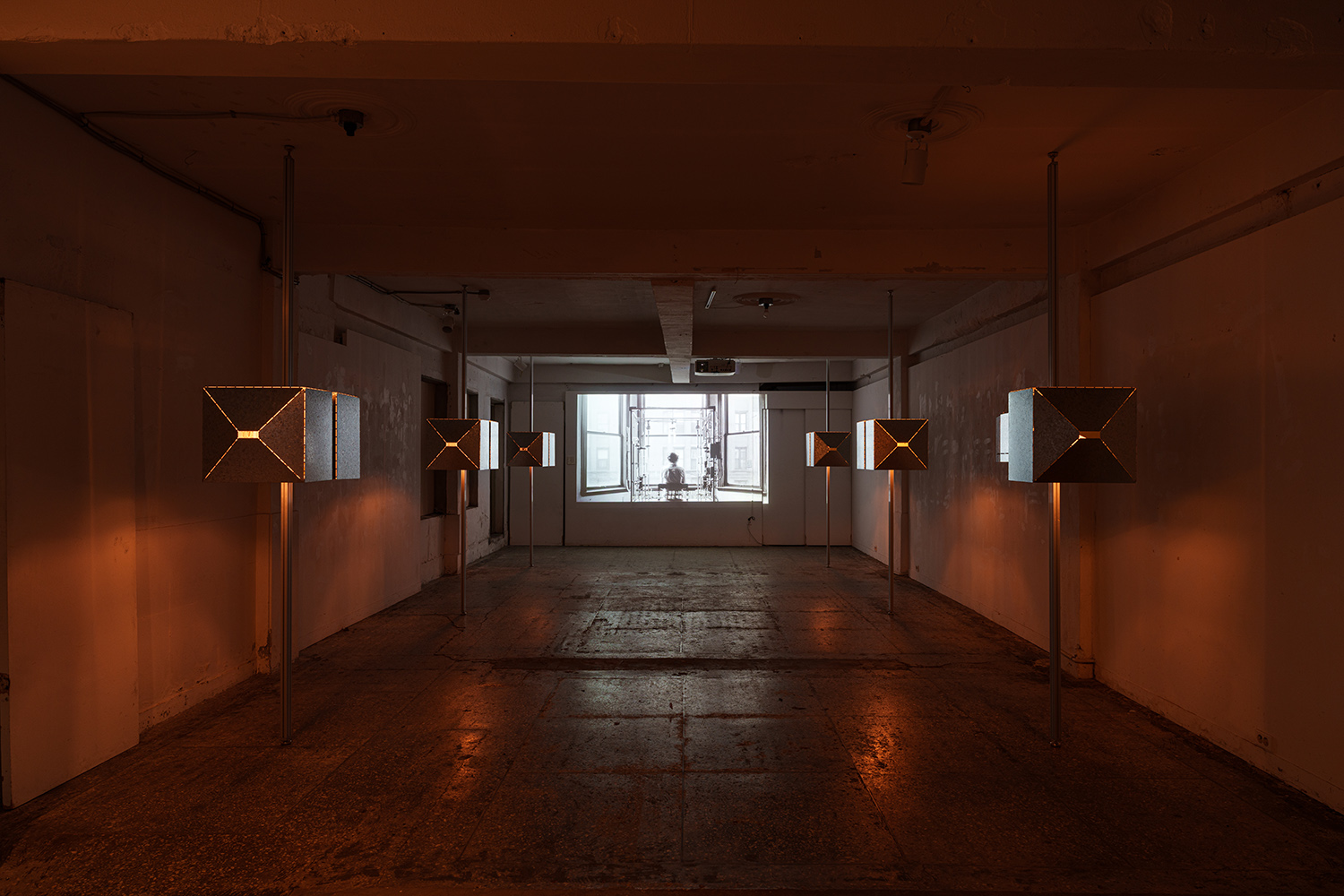
Exhibition view of ‘Without Parallax’ ©Song Yousub
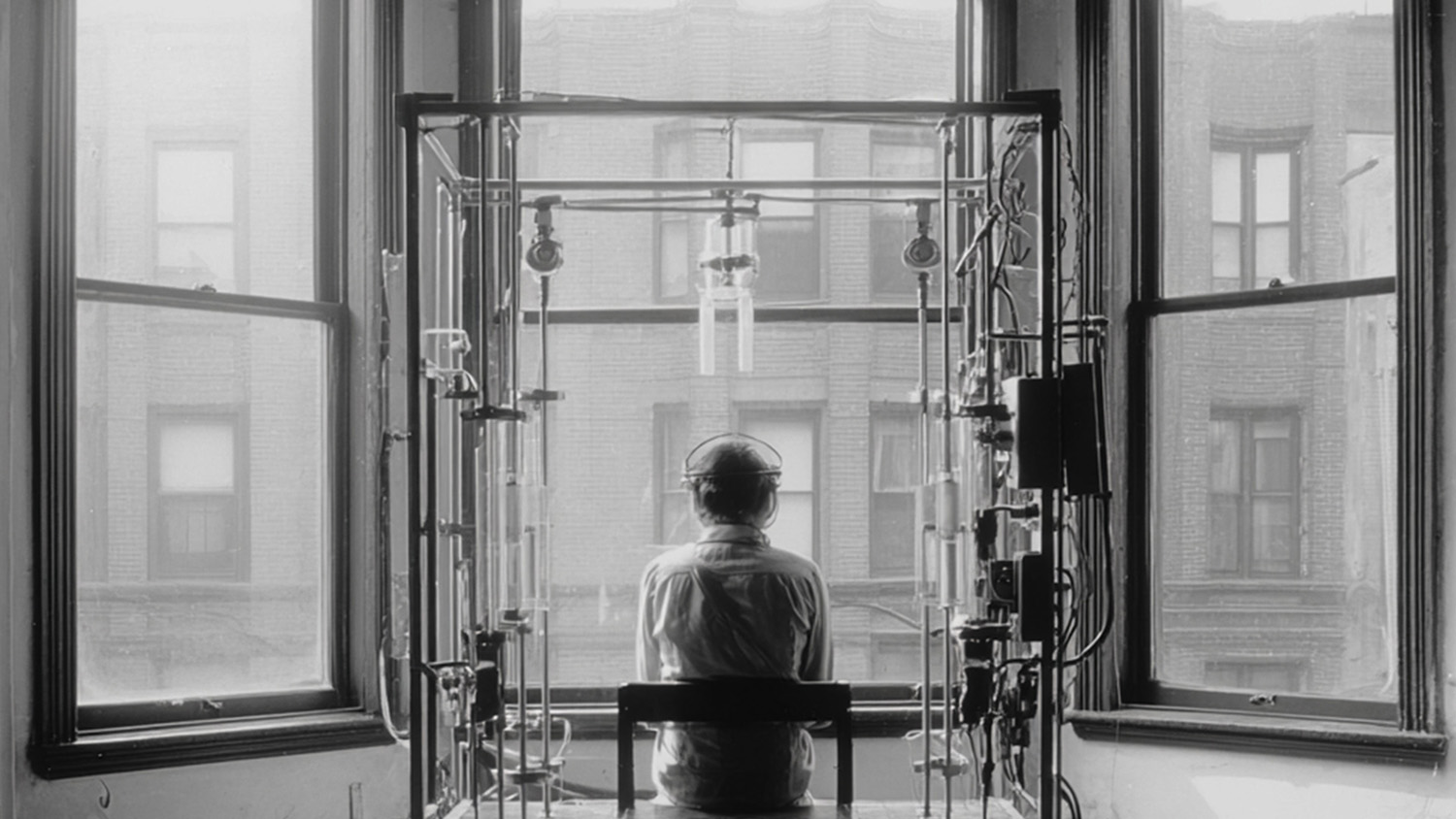
Still image of Eyes of the Epoché ©Cheong Daein
From Nov.15 to 22, the exhibition ‘Without Parallax’ by Cheong Daein (principal, Studio Punctum) was held on the first floor of the Samyook Building. Throughout the exhibition, Cheong experimented an architectural methodology that subtly disrupts the conventional act of ‘seeing’, using mediating fiction. By examining how the gaze, imagination, and technology configure architectural perception, the exhibition unfolds a ‘fictional archaeology’ through drawings, archival materials, short films, and architectural models.
Composed like a triptych, the exhibition begins with ‘Crafting the Fiction’ section. Inside the cabinet de curiosité, a series of silver boxes perforated with small openings, various images are poetically juxtaposed. Drawings about historical materials such as ancient Greek geometry, Renaissance optics, and 19th-century mechanical drawing instruments and Cheong’s research are arranged in a fragmented manner that produces visual transformations. This invites the viewer to experience a fictional history of vision.
The following ‘Eyes of the Epoché’▼1 section presents a short film produced by writing prompts in ChatGPT and generating images through Midjourney. The film narrates the story of a woman abducted by a mad scientist who, after sadistic experiments, loses all her senses except sight. Although she regains her senses once rescued, she remains unable to perceive parallax, having spent her life trapped within a fixed field of view. An architect, attempting to teach her the spatial logic of proximity and distance, engages her in a series of architectural experiments—drawing planes, depicting geometric façades, and constructing three-dimensional understanding through form. These attempts ultimately fail, leading the architect to design a device that ‘twists the vision’ in order to experience her perceptual world in reverse.
Following the short film, the exhibition goes on to ‘Crafting the Vision’ section, realised again through the cabinet de curiosité. This section expands the premise of the film, featuring imagined visual machines, anamorphic reconstruction of space models, and axonometric drawings. Vincent Peu Duvallon (associate professor, Wenzhou-Kean University Michael Graves College of Public Architecture), and also the curator of the exhibition, describes Cheong’s approach as ‘a deconstruction of perspective as a cosmotechtonics’ and ‘an attempt to reconnect with other traditions’. He further interprets these fictions as expressions of ‘alternative imagination’, transforming the fixed viewpoint of Western painting into ‘superimposed and folded spatial fragments’.
A conversation between Cheong and writer Lee Jongkeun was held as an accompanying lecture. Cheong explained that the exhibition began with his intellectual curiosity, emphasising that while he has not ruled out expanding it into actual architectural work, such rigorous exploration must come first. Lee responded that ‘this work represents a starting point rather than a conclusion for the architect; it would be premature to ask what has been unearthed or where the pursuit will end,’ adding, ‘as one carries these questions, new realisations and unexpected encounters emerge. This might itself embody an architect’s way of living, a totality of life.’ Lee also noted, however, that such works must ultimately engage broader realities – where politics, society, science, and non-science intertwine – urging architects to penetrate the world through their own experiential depth and reveal new visions of things. Without a transformation in the ‘seeing subject’, he argued, all discourse risks becoming merely circular. The talk covered a wide range of topics including history, philosophy, literature, and cinema, addressing flows of visual perception in historical and phenomelogical contexts and the challenges faced by contemporary architects born in the 1980s.
_
1 The term ‘Epoché’ originates from the philosopher Edmund Husserl, referring to the suspension of judgment in order to observe consciousness itself.